
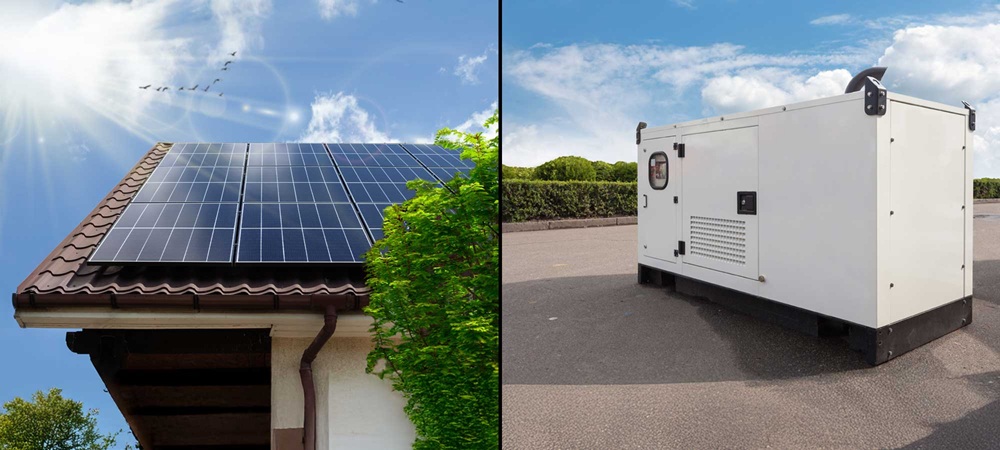
Both solar and generators solve the same immediate problem — the lights stay on — but they behave very differently over a few years of ownership.
The generator
Low purchase cost, high running cost. Fuel is the dominant expense and it scales with every hour of operation. Servicing is regular and non-negotiable, and generators are noisy, produce fumes and need somewhere sensible to live. They handle large, intermittent loads well, which is exactly what they are good at.
Solar with storage
Higher purchase cost, very low running cost. Once installed there is no fuel bill, maintenance is light, and the system is silent. Output depends on sunshine and on the storage capacity that carries you through the evening and through cloudy days.
How to compare them honestly
- Measure your load. Not the total connected load — the load that genuinely has to keep running. Lighting, network, security and a few workstations is a very different proposition from air conditioning across a building.
- Count the outage hours. Estimate how many hours a month you actually run on backup.
- Calculate fuel. Litres per hour multiplied by hours multiplied by price, plus servicing.
- Compare with the solar system sized for that same essential load.
What usually happens
For essential loads running many hours a month, solar with storage tends to pay back and then keep saving. For very large intermittent loads, a generator often remains the sensible option. Many sites end up with both: solar and storage carrying the essentials continuously, and a generator held in reserve for heavy demand.
The important part is that the decision comes from measured consumption rather than from a package size.
Have a question about this? Ask our technical team on WhatsApp.
Chat on WhatsApp